
 EN
EN
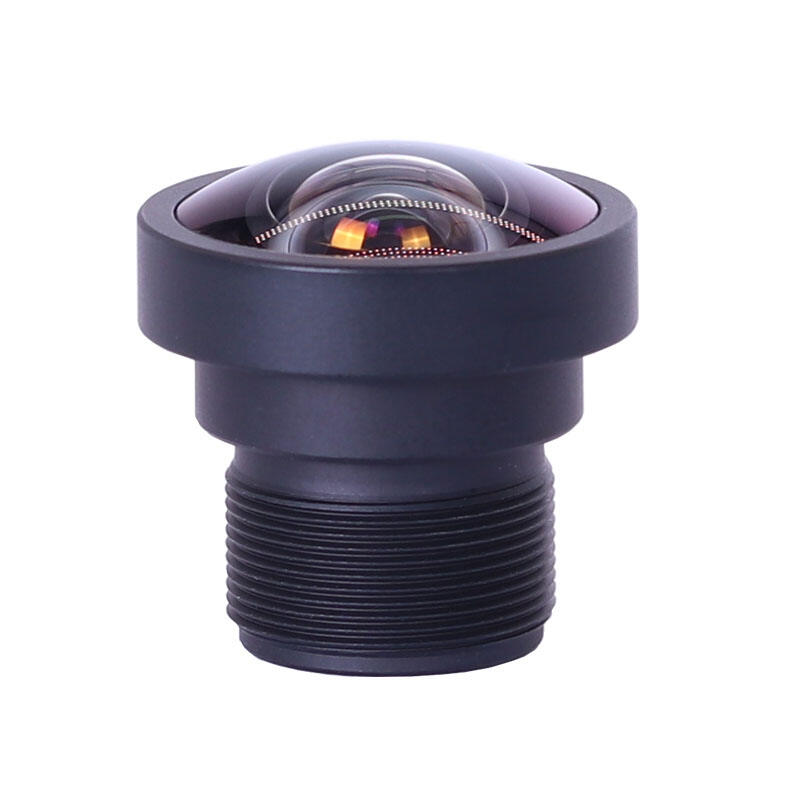
Optical Performance: Matching FOV, Focal Length, and Aperture to Your Application
Field of View and Focal Length Trade-Offs for Sensor Size Compatibility
Selecting the optimal focal length requires balancing Field of View (FOV) requirements with sensor dimensions. A lens designed for a 1/1.7" sensor will exhibit vignetting or edge distortion on a smaller 1/2.5" sensor—degrading image uniformity and sharpness. The FOV formula (DFOV = 2 × tan⁻¹(D/2f), where D = sensor diagonal) shows that shorter focal lengths widen FOV but reduce pixel density for distant objects, limiting resolution in long-range inspection. For M12 lens wholesale procurement, prioritize:
- Sensor-lens compatibility to avoid optical vignetting
- Focal length adjustments calibrated to maintain target resolution at your working distance
Aperture (F-Number) and Lighting Conditions: Balancing NIR Sensitivity and Depth of Field
Aperture (ƒ/#) governs light throughput and depth of field (DoF). Lower ƒ-numbers (e.g., ƒ/1.8) maximize light capture—critical for Near-Infrared (NIR) imaging or low-light factory settings—but narrow DoF by 30–50% compared to ƒ/4 lenses. This trade-off directly affects application performance: high-ƒ/# lenses (ƒ/4–ƒ/8) sustain focus across uneven surfaces but require supplemental lighting; low-ƒ/# options excel in IR inspections yet demand precise focus calibration and stable mounting.
| Parameter | Low-Light Priority (ƒ/1.8) | DoF Priority (ƒ/4.6) |
|---|---|---|
| Light Transmission | 85% higher | Standard |
| Depth of Field | 0.5–1.2 m | 1.8–3.5 m |
| NIR Sensitivity | Optimized | Reduced |
For B2B procurement, verify aperture specifications match both operational lighting conditions and DoF tolerances in your deployment environment.
Mechanical Reliability: M12×0.5 Thread Standards, Flange Back Precision, and Mount Consistency
ISO 68-1 and ISO 965-1 Tolerances: Ensuring Torque Stability and Thread Position Repeatability
Adherence to ISO 68-1 and ISO 965-1 thread standards is non-negotiable for industrial imaging systems. These specifications mandate metric thread profile tolerances within ±0.01mm for pitch diameter and flank angles—preventing thread galling during installation and ensuring consistent clamping force under vibration. Compliant M12×0.5 threads demonstrate less than 5% torque deviation across 10,000 mating cycles, a critical factor for automated production lines where positional repeatability impacts alignment accuracy. Manufacturers validating against these benchmarks reduce field failures by 32%, per 2024 assembly stress testing data.
Back Focal Length Accuracy and Its Impact on Focus Calibration in OEM Camera Modules
Back focal length (BFL) variance directly compromises optical performance in embedded vision systems. Industry data shows that just 0.05mm BFL deviation causes 15% MTF degradation in 12MP sensors. Reputable suppliers achieve ±0.02mm BFL consistency through CNC machining with closed-loop metrology—enabling seamless integration with Sony IMX or ON Semiconductor sensors. This precision eliminates focus recalibration needs during camera module assembly, accelerating OEM throughput by 27% while reducing scrap rates. For M12 lens wholesale procurement, prioritizing BFL traceability certificates mitigates production bottlenecks in high-volume applications.
Wholesale Procurement Best Practices for M12 Lens Buyers
MOQs, Lead Times, and Pre-Threaded Assembly Options in M12 lens wholesale
When procuring M12 lenses wholesale, negotiate Minimum Order Quantities (MOQs) aligned with production forecasts—typically starting around 500 units for standard configurations. Lead times average 4–6 weeks for custom optical assemblies, though pre-threaded options can reduce integration time by 30% in camera module production. For bulk orders exceeding 5,000 units, tiered pricing models often apply, with volume discounts reaching 15–20%, per 2023 industry procurement benchmarks. Always verify thread compliance with ISO 965-1 tolerances before accepting pre-assembled units to ensure mechanical interoperability.
Cleanroom Manufacturing, QA Protocols, and Traceability for High-Reliability B2B Orders
Prioritize suppliers with Class 1000 cleanrooms to prevent particulate contamination affecting lens modulation transfer function (MTF). Rigorous QA protocols should include:
- Automated centration testing with ≤5μm deviation thresholds
- 100% MTF validation under both visible and NIR spectra
- Thermal cycling stress tests (–30°C to 85°C)
Demand full traceability via laser-etched serialization, enabling component-level tracking through automated optical inspection (AOI) systems. This reduces field failure rates by up to 40%, based on 2024 machine vision reliability studies, while ISO 13485-compliant documentation streamlines audit trails for medical and industrial applications.
FAQ
What is the ideal focal length for ensuring optimal field of view?
The ideal focal length balances your field of view requirements with sensor size. It should be calibrated to maintain the target resolution at your working distance while avoiding edge distortion or vignetting.
How does aperture affect depth of field and light transmission?
The aperture, or F-number, determines light throughput and depth of field. Lower F-numbers allow more light but provide a narrower depth of field, making them suitable for low-light conditions or near-infrared imaging.
Why is adhering to ISO thread standards important for M12 lenses?
Adhering to ISO thread standards like ISO 68-1 and ISO 965-1 ensures torque stability, thread position repeatability, and reduces the chance of thread galling, crucial for maintaining mechanical reliability.
What should I consider for wholesale procurement of M12 lenses?
Consider factors such as Minimum Order Quantities (MOQs), lead times, thread compliance, and cleanroom manufacturing with rigorous QA protocols to prevent contamination and ensure high reliability.