
 EN
EN
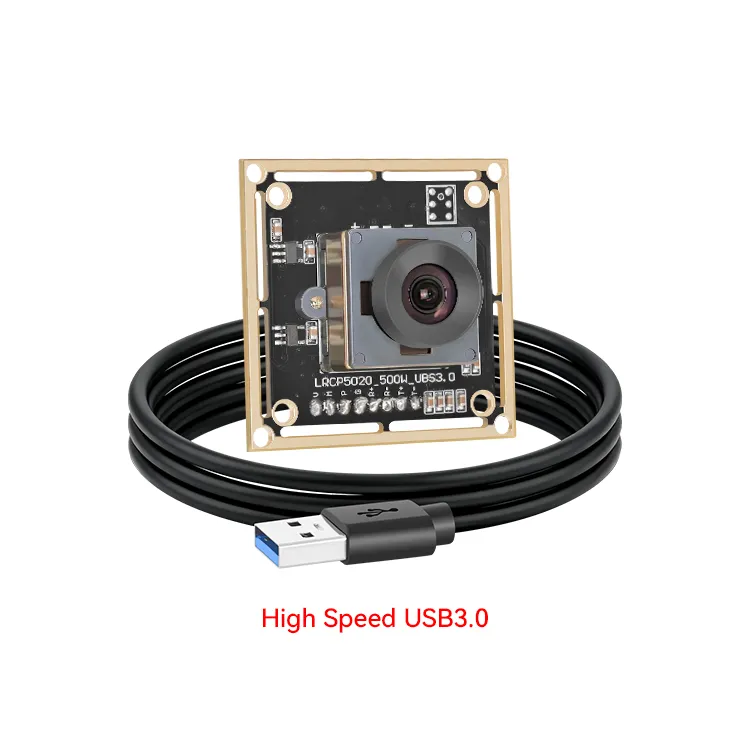
What Defines a High-Performance Mini USB Camera Module?
USB Camera vs. Mini USB Camera Module: Key Functional and Integration Differences
A standard USB camera is a complete, consumer-facing device—typically housed, lens-equipped, and optimized for plug-and-play use. In contrast, a mini USB camera module is a board-level component engineered for embedded integration: compact, stripped of extraneous housing, and built around a tightly integrated image sensor, lens mount, and signal-processing circuitry on a small PCB. Its design prioritizes space efficiency and flexibility—enabling direct soldering, ribbon-cable interfacing, or custom mounting in constrained environments like medical devices, drones, or industrial kiosks.
Crucially, many high-performance mini modules include an onboard ISP (image signal processor), offloading critical tasks like auto-exposure, noise reduction, and color correction from the host CPU. This not only improves power efficiency and reduces latency but also strengthens signal integrity by minimizing analog path length and EMI exposure—key advantages over bulkier USB cameras reliant on external connectors and unshielded cables.
The trade-off is engineering effort: while standard USB cameras deliver immediate functionality, mini modules demand thoughtful system-level integration—but reward that investment with superior customization, thermal control, and long-term reliability.
UVC Compliance as the Foundation for Seamless Plug-and-Play Operation
UVC (USB Video Class) compliance is non-negotiable for interoperability—it ensures the module enumerates automatically as a standard video device across Linux, Windows, macOS, and Android, eliminating the need for proprietary drivers or kernel modifications. For developers building on platforms like Raspberry Pi or ARM-based edge gateways, this accelerates prototyping and simplifies deployment.
However, true high-performance UVC support goes beyond basic enumeration. Leading modules implement UVC 1.5, enabling standardized, vendor-agnostic control over exposure, white balance, gain, frame rate, and streaming formats via class-compliant HID requests. This guarantees robust compatibility with industry-standard frameworks—including OpenCV, GStreamer, and DirectShow—without workarounds or firmware patches.
For B2B deployments, full UVC compliance also streamlines firmware updates, cross-platform validation, and long-term maintenance—reducing integration risk and supporting scalable, future-proof system architecture.
Critical Technical Criteria for Selecting a Mini USB Camera Module
Resolution, Frame Rate, and Sensor Options (OV, Sony, GC) for Target Use Cases
Resolution and frame rate must be matched precisely to application requirements—not maximized unnecessarily. A 2MP/30fps module suffices for barcode scanning or presence detection; industrial inspection or high-speed motion analysis may require 5–20MP sensors at 60+ fps with global shutter to eliminate motion blur.
Sensor choice critically shapes performance:
- Sony sensors (e.g., IMX385, IMX477) lead in low-light sensitivity, dynamic range, and NIR response—ideal for outdoor, surveillance, or machine vision applications.
- OmniVision (OV) sensors (e.g., OV5640, OV9281) offer strong cost-performance balance for general-purpose embedded imaging, with proven stability in mass production.
- GalaxyCore (GC) sensors provide competitive mid-tier alternatives, often with optimized power profiles for battery-constrained designs.
Equally important are pixel architecture (BSI vs. FSI), shutter type (rolling vs. global), and native bit depth—all of which affect motion fidelity, lighting adaptability, and post-processing headroom.
OS and Platform Compatibility: Linux, Raspberry Pi, ARM, and Real-Time OS Support
While UVC compliance ensures broad OS compatibility, embedded deployments demand deeper validation. Not all UVC implementations behave identically under resource-constrained environments like Raspberry Pi OS, Yocto-built Linux, or real-time operating systems (RTOS). Key considerations include:
- Verified support for V4L2 controls (exposure, gain, AWB) without vendor-specific extensions;
- Consistent frame capture latency and USB bandwidth allocation under sustained load;
- Power management behavior (e.g., suspend/resume reliability during idle periods);
- ISP-assisted preprocessing to reduce host CPU load—especially vital for edge AI inference pipelines running concurrently with video capture.
Modules with mature, field-tested UVC firmware—validated on target SBCs and RTOSes—minimize integration surprises and ensure deterministic timing for time-sensitive applications.
Design Flexibility and Real-World Integration Considerations
Form Factors: Bare PCB, S-Mount, and Enclosed Modules—Size, Thermal, and Mounting Trade-offs
Form factor dictates mechanical integration, thermal behavior, and shielding effectiveness:
- Bare PCB modules (e.g., 8×8 mm) maximize space savings and enable direct PCB-level integration, but require careful attention to heat dissipation, EMI mitigation, and lens alignment—best suited for volume-manufactured wearables or compact IoT devices.
- S-mount modules standardize lens attachment (M12, M6) and simplify optical calibration, though they introduce mechanical tolerance dependencies during assembly.
- Enclosed modules add protective housing, dust resistance, and passive cooling—ideal for industrial kiosks or outdoor enclosures—but increase footprint and limit airflow.
Select based on your enclosure’s available volume, ambient temperature profile, and production capabilities—not just datasheet dimensions.
Lens Selection and Imaging Enhancements: Aperture, WDR, Low-Light Performance, and IR Support
Image quality emerges from the system—not the sensor alone. Lens and sensor must be co-optimized for working distance, field of view, and lighting conditions.
- A wider aperture (e.g., f/1.6) boosts low-light sensitivity but narrows depth of field—ideal for fixed-focus scanning, less so for variable-distance applications.
- Wide Dynamic Range (WDR) uses multi-exposure fusion to preserve detail in high-contrast scenes (e.g., doorways with backlighting), though it increases processing latency and bandwidth.
- Backside-illuminated (BSI) sensors achieve usable output down to 0.1 lux; pairing them with lenses featuring high transmission coatings further enhances NIR performance.
- Integrated IR-cut filters and IR LEDs enable reliable day/night switching—eliminating the need for external illuminators in security or robotics applications.
| Enhancement | Benefit | Cost Trade-off |
|---|---|---|
| Wider aperture | Brighter low-light image | Shallow depth of field |
| WDR | Balanced exposure in high contrast | Higher processing load |
| IR support | 24/7 operation without visible light | Additional power & size |
Always validate lens MTF, distortion, and spectral response against your specific use case—not just nominal specs.
Reliability, Scalability, and Supply Chain Readiness for B2B Deployment
In B2B embedded deployments, technical excellence means little without long-term manufacturing reliability. A high-performance mini USB camera module must be backed by a supplier with demonstrable discipline in three areas:
Reliability: Rigorous in-process testing (e.g., burn-in, thermal cycling, ESD validation), documented MTBF data (>50,000 hours typical for industrial-grade modules), and adherence to ISO 9001, RoHS, and REACH standards. Certifications should be auditable—not just claimed.
Scalability: Capacity to ramp production without compromising yield or spec consistency—enabled by automated optical alignment, AOI (automated optical inspection), and dual-sourcing strategies for critical components like sensors and connectors.
Supply Chain Resilience: Proven ability to navigate component shortages, port delays, or sudden demand spikes—supported by buffer inventory, regional logistics partnerships, and transparent communication protocols for order status and risk escalation.
A module that excels in the lab but falters in volume production erodes trust, delays time-to-market, and inflates total cost of ownership. Therefore, vendor due diligence—assessing not just datasheets but quality systems, manufacturing maturity, and supply chain transparency—is as essential as evaluating resolution or frame rate.
FAQs
What is the difference between a mini USB camera module and a standard USB camera?
A standard USB camera is a complete consumer device designed for plug-and-play use, while a mini USB camera module is a compact board-level component meant for embedded integration, offering flexibility and space efficiency.
What does UVC compliance mean for mini USB camera modules?
UVC compliance ensures automatic enumeration as a standard video device across major operating systems, enabling seamless plug-and-play functionality without proprietary drivers or kernel modifications.
Which sensors are best for specific applications?
Sony sensors excel in low-light sensitivity and dynamic range, OmniVision provides strong cost-performance options for general use, and GalaxyCore excels in mid-tier applications with optimized power profiles.
Why is supplier reliability crucial for mini USB camera modules?
Supplier reliability ensures long-term manufacturing consistency, adherence to quality standards, and resilience against supply chain challenges, which is vital for time-sensitive B2B deployments.