
 EN
EN
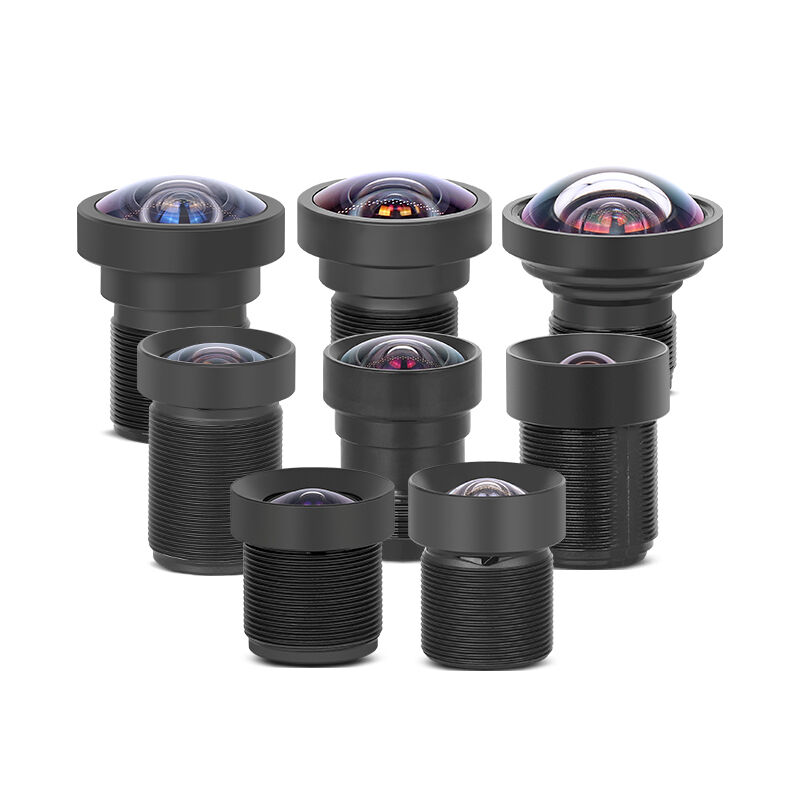
Core M12 Lens Selection Criteria for USB Cameras
Matching Focal Length and Field of View to Application Requirements
Selecting the optimal focal length is foundational to M12 lens for USB camera performance. For close-range inspection—such as PCB defect detection—a 2–3mm lens delivers a wide FOV (120°+) ideal for capturing broad areas without repositioning. In contrast, long-range identification tasks like warehouse inventory tracking require 8–12mm lenses with narrower FOVs (30°–50°) to isolate targets precisely. Industrial studies confirm that FOV mismatches contribute to ~40% efficiency loss in automated vision systems due to missed detections or costly rework.
- Critical trade-offs: Wider FOVs introduce barrel distortion (>5%), while telecentric designs minimize perspective error at the expense of light throughput
- Environmental factors: In vibration-prone settings, lenses must maintain <0.1° alignment tolerance to prevent focus drift
Ensuring Sensor Compatibility: Resolution, Pixel Size, and Image Circle Coverage
Sensor-lens compatibility directly governs image fidelity. A 5MP USB camera with 2.4µm pixels demands an M12 lens resolving ≥140 line pairs/mm to avoid aliasing. Undersized image circles (<φ6mm) cause severe corner vignetting on 1/2.5” sensors; oversized lenses (>φ8mm) add unnecessary weight and cost without optical benefit.
| Parameter | Mismatch Risk | Optimal Tolerance |
|---|---|---|
| Image Circle | Corner shading (>30% light loss) | Sensor diagonal + 10% |
| Resolution | Blurred details (MTF <20% at Nyquist) | Sensor resolution × 1.5 |
| Pixel Size | Chromatic aberration (≥3µm pixels) | f/# > pixel size (µm) |
Thermal expansion differentials between lens barrels and sensor housings can induce focus shift exceeding 150µm at 60°C—making mechanical stability validation through 10,000 thermal cycles essential for industrial-grade USB cameras.
USB-Specific Integration Challenges and M12 Lens Constraints
Mount Precision, Focus Mechanism, and Thermal/Mechanical Stability in Embedded USB Modules
Micron-level mount precision is non-negotiable: even minor misalignment degrades image sharpness and registration accuracy in compact USB modules. Fixed-focus designs dominate due to space constraints, requiring precise factory calibration. Thermal stability is critical—industrial deployments face swings beyond 60°C, where focus can shift by 0.05mm per 10°C (Optical Engineering Journal, 2023). Automotive-grade USB cameras further demand resistance to 15G mechanical shocks without optical path degradation. Rigorous pre-deployment testing—including thermal cycling from –40°C to 85°C and ISTA 3A vibration simulations—is mandatory.
Optical-Electrical Alignment with USB Camera Boards
Optical-electrical synchronization dictates functional reliability. The lens must sit perfectly perpendicular to the sensor plane: a tilt of just 0.5° measurably softens corners in 5MP+ modules. Back focal distance (BFD) tolerances tighter than ±0.1mm are required to prevent vignetting while ensuring full image circle coverage aligns with the sensor’s active area. On compact USB boards, infrared cut filter alignment is especially sensitive—misalignment causes color shifts impacting ~12% of machine vision applications (Imaging Science Report, 2024). Additionally, ungrounded lens barrels risk EMI coupling from USB 3.0 data lines, potentially corrupting high-resolution video streams.
Practical M12 Lens Types for USB Vision Applications
Wide-Angle, Macro, and Varifocal Lenses — Use-Case Fit for Compact USB Inspection Systems
Wide-angle M12 lenses (2–4mm) excel in confined spaces—like machinery interiors or vehicle cabins—where panoramic coverage is needed without physical repositioning. Macro lenses deliver sub-millimeter resolution for close-up inspection of circuit traces or medical components. Varifocal lenses offer field-of-view flexibility across varying working distances, eliminating the need for multiple fixed lenses in dynamic environments. Each type addresses distinct integration priorities: wide-angle minimizes spatial constraints, macro ensures detail fidelity at short range, and varifocal supports adaptive setups. For compact USB inspection systems, this strategic selection balances optical performance, system footprint, and operational agility.
Validating Optical Performance and Finalizing Your M12 Lens for USB Camera Choice
Validation must occur under real-world operating conditions—not just lab settings. Use ISO 12233 test charts to assess resolution consistency across expected working distances. Quantify distortion, chromatic aberration, and vignetting at multiple apertures. Thermal cycling tests between –20°C and 70°C expose focus shift issues observed in 38% of industrial deployments. Mechanical validation includes vibration trials matching your environment’s severity and flange distance verification within ±0.05mm to preserve focus integrity.
Finalize your choice by cross-referencing test outcomes against core requirements:
- FOV coverage at target working distances
- Resolution alignment with sensor pixel pitch
- Retention of optical alignment under thermal and mechanical stress
- Consistent contrast and clarity under operational lighting (e.g., LED flicker, IR illumination)
This evidence-based process eliminates assumptions. It confirms whether wide-angle, macro, or varifocal optics best serve your USB camera’s mission—while maintaining compactness, reliability, and cost discipline. Proper validation prevents late-stage redesigns and ensures robust image capture in production-critical USB vision systems.
FAQ
What is the significance of choosing the correct focal length for M12 lenses in USB cameras?
The correct focal length ensures that the field of view (FOV) matches the application requirements. For close-range tasks, a wider FOV is necessary, while long-range tasks require narrower FOVs for precise isolation of targets.
How can thermal expansion affect USB cameras?
Thermal expansion between lens barrels and sensor housings can shift the focus, affecting image quality. This can be mitigated by validating mechanical stability through thermal cycle testing.
Why is mount precision crucial for USB camera integration?
Micron-level mount precision ensures optimal image sharpness and accuracy. Even minor misalignments can degrade these aspects in USB modules.
What tests are recommended to validate M12 lens performance for USB cameras?
Tests should include ISO 12233 charts for resolution consistency, distortion and aberration assessments, thermal cycling, and mechanical vibration trials to ensure robustness under operating conditions.